I Tried Heart-Brain Coherence, What I Didn’t Expect Was To Be Confronted By My Own Spiritual Life.
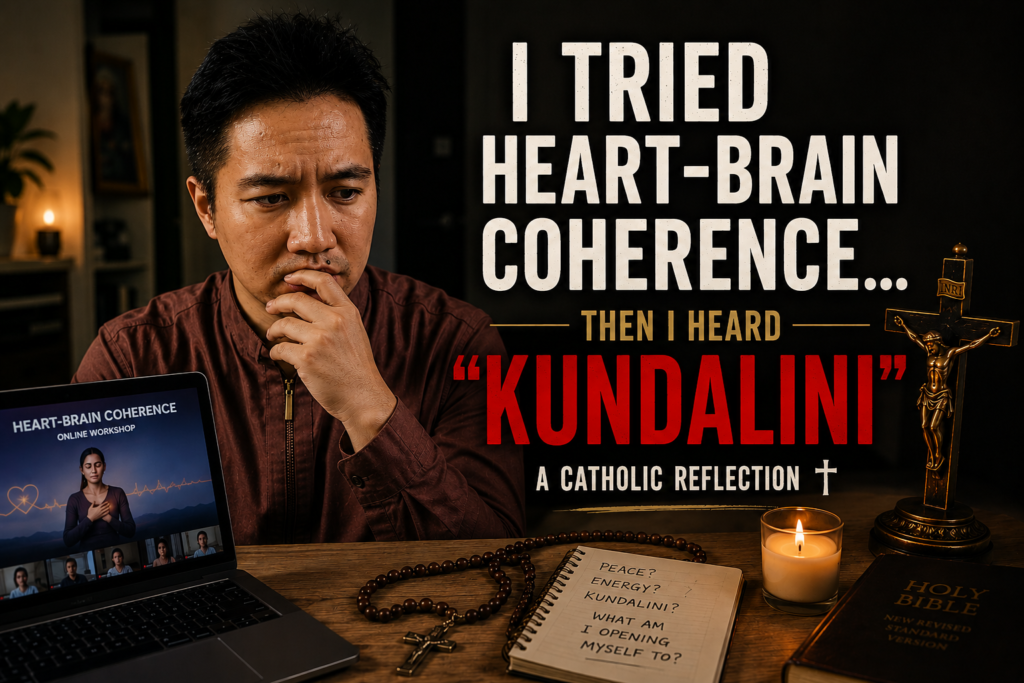
A few nights ago, I found myself sitting in front of my laptop waiting for an online Heart-Brain Coherence workshop to begin. Looking back now, it still feels slightly surreal that I was even there. If you had asked me a year ago whether I would spend my weekday evening inside a meditation-style Zoom room, I probably would have laughed and said no without thinking twice.
Not because I have anything against mindfulness. As a two-time Stage 4 cancer survivor, I take nervous system regulation seriously. When your body has endured high-dose chemotherapy and near-death hospital stays, you quickly learn that cortisol and chronic stress are quiet killers. I am always curious about practical tools that help the body reset.
Furthermore, I was looking at this through the lens of experience architecture and wellness. Over the past year, I have been thinking deeply about hospitality and retreat design. On the surface, people book holidays for relaxation, but what they are really purchasing is an emotional state: deep rest, mental clarity, and nervous system relief. I wanted to see firsthand how Heart-Brain Coherence was being taught and experienced.
So I logged into the call with an open mind, a notebook ready, and zero spiritual expectations.
The First Half: Simple, Grounded Biology
For the first 45 minutes, the session was remarkably sensible. The facilitator walked us through the physiological science of heart rate variability (HRV). The mechanics were straightforward: when you breathe at an even rhythm, roughly five seconds in and five seconds out, your heart rhythm synchronizes with your respiration. This sends afferent signals to your brain that shift your autonomic nervous system from sympathetic fight-or-flight into parasympathetic rest-and-digest.
Nothing mystical there. God designed the human body with precision. Breath regulates biology. Slowing down your breathing slows down a racing pulse. We then layered in feelings of gratitude, which naturally softens muscular tension and lowers blood pressure.
I felt relaxed. My shoulders dropped. It felt like a solid, evidence-based wellness practice that anyone could benefit from after a frantic work week.
Then the facilitator shifted gears.
When My Internal Alarm Went Off: The Word “Kundalini”
As the guided session progressed deeper, the language subtly transformed. We were no longer talking about autonomic nervous system signals or breath mechanics. The guidance moved toward visualizing energy rising from the base of the spine, unblocking subtle energy centers, and channeling kundalini energy upward through the body.
The moment the word Kundalini was uttered, my internal radar lit up.
It was not panic. I did not slam my laptop shut or jump out of my chair in shock. But an immediate, unmistakable spiritual alertness kicked in. Every bit of passive relaxation vanished.
Now, I do not believe in being reactionary or condemning well-meaning wellness facilitators. The instructor was kind, gentle, and clearly intended to help people feel calm. But as a practicing Catholic, theology matters. The source of our spiritual life matters. You cannot treat spiritual frameworks as interchangeable buzzwords.
In Eastern esoteric traditions, kundalini is not simply a biological relaxation response. It is understood as a latent spiritual serpent power seated at the base of the spine. When you invite that energy to rise and open your spiritual channels without boundaries, you are stepping out of the realm of physiology and stepping into spiritual territory.
A person can sincerely desire peace and still knock on the wrong door. You cannot open spiritual windows and assume that whatever comes through the draft is automatically benign.
The Experiment: Can You “Baptize” the Breathing?
After the Zoom session ended, I sat alone in my study in silence. I did not feel angry, but I was deeply reflective.
I asked myself a straightforward question: Was the breathing itself bad?
Clearly not. God created oxygen. God formed Adam from the dust and breathed life into his nostrils. The 5-second rhythmic breath is simply biology. The problem was not the lungs; it was the spiritual altar the practice was being laid on.
So I wondered: What if I strip away every trace of vague energy language and redirect the entire practice toward Christ?
Instead of visualizing undefined energy channels, what if I meditated on the Sacred Heart of Jesus? Instead of summoning kundalini, what if I invited the Holy Spirit? Instead of unblocking centers, what if I prayed for the Precious Blood of Jesus to cleanse, protect, and heal my soul?
It sounded like a clean, elegant solution. “Baptize” the technique. Make it Catholic.
So I closed my eyes, breathed in slowly for five seconds, and began to pray.
The Uncomfortable Mirror: When Conviction Replaces Calm
Here is where the evening took a turn I never anticipated.
When I had been participating in the general meditation with vague words like “light,” “universal peace,” and “gratitude,” it was easy to feel pleasant and comfortable. Vague concepts never hold you accountable. They demand nothing of your conscience. They give you a warm sensation without ever asking who you are or how you are living.
But the moment I said, “Lord Jesus Christ, fill my heart with Your presence,” everything shifted from abstract wellness into an intimate, piercing encounter.
Jesus is not a meditation vibe. He is not a psychological archetype or a warm energy current. He is a living Person. And when you stand in front of a living Person who loves you completely, you cannot hide behind curated spiritual aesthetics.
As I prayed, “Sacred Heart of Jesus, draw me near,” I did not feel instant fluffy comfort. I felt an immediate, quiet conviction about the distance I had let slip into my spiritual life.
I was confronted by reality:
- I had not been to confession in nearly a month.
- My daily Scripture reading had become sporadic, replaced by scrolling and work demands.
- My prayer life had turned into hurried check-ins between projects rather than real communion.
Nobody had to lecture me. There was no thunder or dramatic lightning. Just the gentle, undeniable light of Christ revealing that while my external life looked productive and faithful, my heart had quietly drifted.
When the exercise was centered on energy, I felt caution. But when the prayer was centered on Jesus, I felt conviction. The first made me step back; the second made me want to repent and return home.
Breath Belongs to the Creator: A Christ-Centered Framework
I do not believe Christians should live in superstitious fear of biology. You do not need to abandon slow breathing, exercise, or nervous system health. During my cancer treatments, slow diaphragmatic breathing kept me grounded through severe nausea and pain. Our faith has a rich, ancient contemplative tradition of breath prayer, such as the Jesus Prayer (“Lord Jesus Christ, Son of God, have mercy on me, a sinner”) practiced by the Desert Fathers for centuries.
However, as Christians, we must be spiritually discerning. We cannot divorce true peace from the Prince of Peace.
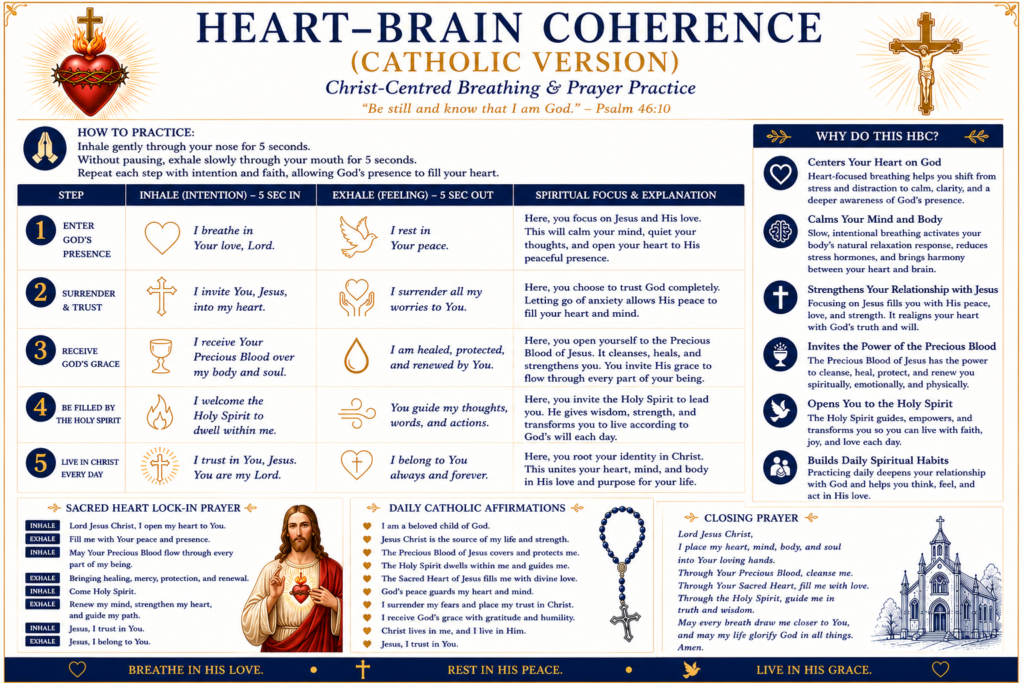
To help myself integrate healthy nervous system regulation with authentic Catholic prayer, I formalized a simple, Christ-centered protocol:
- Inhale (5 Seconds): Breathe in slowly through the nose, asking the Holy Spirit to fill your mind with clarity, humility, and grace.
- Heart Focus: Anchor your attention on the Sacred Heart of Jesus, overflowing with infinite mercy, rather than vague energy centers.
- Exhale (5 Seconds): Release tension, anxiety, and self-reliance, surrendering your day into the hands of the Father.
- Spiritual Covering: Pray the Precious Blood of Jesus over your family, your health, and your home for protection and renewal.
This small shift turned what could have been a compromised wellness routine into a genuine moment of daily repentance and peace.
Looking for Authentic Faith, Catholic Community & Spiritual Discernment?
Navigating modern wellness, workplace pressures, and cultural trends while holding fast to Christ is not meant to be done alone. If you are seeking genuine community, real testimonies, and faithful resources in Malaysia, here are two initiatives we lead:
- ✝️ Catholic Unite Malaysia: Connecting young adults, professionals, and families across parishes for spiritual fellowship and mutual growth.
- 📖 Christian Faith Story: Personal, raw testimonies of physical healing, conversion, and walking with Jesus through life’s hardest battles.
- 📄 Printable Catholic Heart-Brain Guide: A clean 1-page A4 reference sheet keeping the 5-second breath rhythm anchored strictly in the Sacred Heart of Jesus.
If you would like to print out the A4 reference sheet for your prayer desk or quiet time, click the download button above or view the preview image below:
May every breath we take lead us back to the Cross. Jesus, I trust in You.